


Residential energy storage batteries allow homeowners to store surplus solar power for evening use and emergency power backup. Many urban apartments and compact residences face a common headache: limited usable floor area. Homeowners exploring solar and battery storage quickly run into a common practical question. How to pick a residential energy storage battery that matches available installation space, daily power loads, and backup requirements during grid outages. LiFePO4 batteries have become the preferred option for residential energy storage because of stable thermal performance, long cycle life and low risk of thermal runaway. Three mainstream formats, wall-mounted LiFePO4 batteries, rack-mounted LiFePO4 batteries and floor-standing LiFePO4 batteries, are built to solve different real-world household challenges.
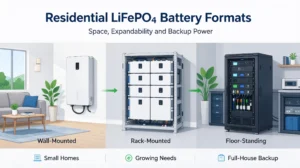
Can wall-mounted LiFePO4 batteries solve space shortages for small homes?
Many urban apartments and compact residences face a common headache: limited usable floor area. Homeowners want solar battery backup but worry that bulky storage equipment will take up precious living space. Wall-mounted LiFePO4 batteries are designed directly for this constraint.
These slim battery units mount vertically onto solid load-bearing walls instead of occupying floor space. Qualified installers will check wall structural capacity before fixing the hardware. Wiring can be neatly arranged along the wall, and routine inspections can happen without moving furniture or rearranging household belongings.
Most wall-mounted residential energy storage batteries deliver enough stored power to keep critical circuits working during blackouts. Refrigerators, home lighting, internet routers and essential communication devices can continue operating when the public grid fails. When paired with hybrid inverters, the system automatically switches operating modes. Solar energy captured during daytime gets stored inside the battery for evening use, cutting electricity drawn from the grid during expensive peak tariff hours. Many wall-mounted units can be installed in garages or utility rooms as long as the location stays dry and maintains suitable ambient temperature.
Can rack-mounted LiFePO4 batteries adapt to growing household power consumption?
Many families hesitate to lock in a fixed battery capacity right away. Power needs often change over time. A household may later add an electric vehicle charger, build home extensions or install more high-power electrical devices. Rack-mounted LiFePO4 batteries address this concern with modular architecture.
Individual battery modules fit into standard racks. Homeowners can start with a smaller configuration to match current power demands. When energy needs increase in the future, extra modules can be added to expand total storage capacity. Each module can be inspected or replaced separately. This design reduces downtime if one single module develops faults.
Rack-mounted LiFePO4 batteries support series and parallel connections to raise overall system capacity and output power. Multi-story houses and villas with multiple high-power appliances often choose this type of battery. Installers can easily access each module during regular maintenance and system diagnostics. The standardized rack layout supports consistent thermal management across the whole battery bank. Households in remote areas with unstable grid infrastructure can even build small residential microgrids based on rack-mounted LiFePO4 batteries.
Can floor-standing LiFePO4 batteries provide reliable full-house power backup?
Some property owners need enough stored energy to run multiple heavy appliances at once during grid outages. Partial backup for lights and small electronics cannot meet their requirements. Floor-standing LiFePO4 batteries are built for these heavy-load residential scenarios.
The complete battery cabinet stands independently on the floor. Battery cells, BMS hardware and thermal control components are integrated inside one sturdy enclosure. These systems can support simultaneous operation of air conditioning units, water heating systems and major kitchen equipment. Basements and dedicated equipment rooms are typical installation locations for floor-standing LiFePO4 batteries.
The large cabinet body accommodates effective air cooling or liquid cooling designs. Internal temperature remains stable under heavy continuous discharge or high ambient temperature conditions. Floor-standing LiFePO4 batteries feature strong overload tolerance and longer continuous discharge duration. Households that suffer from frequent and extended power outages often select this solution to keep the entire property operational. Installers must verify floor load capacity and reserve sufficient ventilation space around the cabinet before installation.
What practical factors should homeowners compare before choosing residential energy storage batteries?
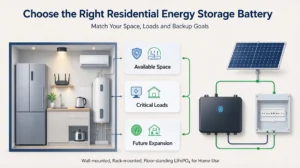
Space availability is only one part of the decision process. Homeowners need to work through several real considerations before selecting residential energy storage batteries.
They need to measure available installation space and confirm wall or floor load limits. It is important to list exactly which electrical loads must remain active during power cuts. Families should also forecast whether household power demand will rise in the coming years. Inverter compatibility and local electrical installation codes cannot be overlooked.
Safety requirements differ for each installation style. Wall-mounted LiFePO4 batteries require solid mounting surfaces to avoid structural risks. Rack-mounted LiFePO4 batteries need secure inter-module connections to prevent loose contacts under vibration. Floor-standing LiFePO4 batteries must maintain clear ventilation gaps to avoid heat buildup. Testing bodies carry out strict performance checks under extreme temperature, physical impact and repeated charge-discharge cycles. These tests define installation rules and reduce hidden operating hazards.
How do fluctuating energy prices influence residential battery investment decisions?
Energy prices keep shifting in many regions. More homeowners pair rooftop solar arrays with residential energy storage batteries to gain better control over electricity expenses. Surplus solar power no longer flows back to the grid at low compensation rates. Instead, it gets stored inside batteries for evening consumption or emergency backup.
Wall-mounted, rack-mounted and floor-standing LiFePO4 batteries each target distinct household challenges. Space constraints, backup scope and long-term energy plans will shape the final selection. Every home has unique site conditions and power usage habits. There is no universal battery solution that fits all residential properties.
Will your home’s layout and power backup goals point you toward wall-mounted, rack-mounted or floor-standing LiFePO4 residential energy storage?