


Why Are Low Voltage LiFePO4 Batteries Widely Used in Modern Energy Storage Systems?
As renewable energy continues to develop, solar power systems are becoming an important source of electricity for residential, commercial, and off-grid applications. However, solar energy production is affected by sunlight availability, which makes energy storage technology essential for maintaining a stable power supply.
Low Voltage LiFePO4 Batteries have become one of the most commonly used energy storage solutions due to their high safety, excellent cycle performance, and stable operating characteristics.
Compared with traditional lead-acid batteries, lithium iron phosphate batteries provide higher energy efficiency, longer service life, and better charging and discharging performance. These advantages make them suitable for different solar energy storage applications, from small independent systems to larger residential and commercial projects.
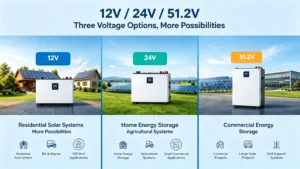
Different voltage configurations, including 12V LiFePO4 Batteries, 24V LiFePO4 Batteries, and 51.2V LiFePO4 Batteries, allow energy storage systems to be designed according to different power requirements.
What Are Low Voltage LiFePO4 Batteries and How Do They Work?
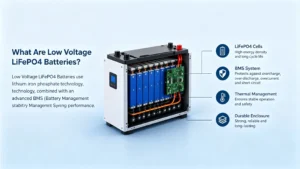
Low Voltage LiFePO4 Batteries are lithium-ion energy storage batteries that use lithium iron phosphate as the cathode material. They are designed to provide stable DC power output for solar energy systems, backup power applications, and off-grid electricity solutions.
A typical solar energy storage system includes:
- Solar panels for electricity generation
- Solar inverters for power conversion
- Battery systems for energy storage
- Energy management systems for monitoring and control
During periods of sufficient sunlight, solar panels generate electricity. Part of the energy can be used directly, while excess electricity is stored in the battery. When solar generation decreases or electricity demand increases, the stored energy can be released to supply power.
Low voltage battery systems are popular because they offer flexible installation, simple system design, and compatibility with many small and medium-scale energy storage applications.
Why Are LiFePO4 Batteries Suitable for Solar Energy Storage?
How Does LiFePO4 Technology Improve Battery Safety?
Safety is one of the most important considerations in energy storage systems.
LiFePO4 battery chemistry has excellent thermal stability compared with many traditional lithium battery technologies. The stable chemical structure helps reduce the risk of overheating during normal operation.
For solar applications, batteries may experience frequent charging and discharging cycles. A stable battery chemistry helps maintain reliable performance over long periods.
Why Do LiFePO4 Batteries Have a Longer Cycle Life?
Energy storage batteries are expected to operate for many years, making cycle life an important factor.
LiFePO4 batteries can support a large number of charge and discharge cycles while maintaining good performance. This characteristic makes them suitable for daily solar energy storage applications.
A longer cycle life can help:
- Reduce battery replacement frequency
- Improve system reliability
- Lower long-term maintenance requirements
How Do LiFePO4 Batteries Improve Solar Energy Utilization?
Solar panels generate electricity mainly during daytime hours, while electricity demand often continues throughout the evening and night.
Energy storage systems equipped with Low Voltage LiFePO4 Batteries can store unused solar power and release it when electricity is needed.
This helps:
- Increase solar energy self-consumption
- Reduce wasted renewable energy
- Provide backup power capability
What Are the Differences Between 12V, 24V and 51.2V LiFePO4 Batteries?
Different voltage levels are designed for different energy storage requirements. Choosing the correct battery voltage depends on system size, power demand, inverter compatibility, and installation conditions.
What Applications Are Suitable for 12V LiFePO4 Batteries?
12V LiFePO4 Batteries are commonly used in smaller energy storage systems where compact size and easy installation are important.
Typical applications include:
- Small solar power systems
- RV and mobile energy solutions
- Marine power systems
- Portable backup power equipment
The 12V configuration is suitable for applications with relatively low power requirements. It provides an efficient alternative to traditional 12V lead-acid batteries with improved lifespan and performance.
When Should You Choose 24V LiFePO4 Batteries?
24V LiFePO4 Batteries are often used in medium-sized energy storage systems that require higher voltage output than 12V systems.
Common applications include:
- Residential solar systems
- Small off-grid power systems
- Remote energy projects
Compared with lower voltage systems, 24V battery configurations can reduce current flow under the same power conditions, which may improve system efficiency and reduce cable losses.
Why Are 51.2V LiFePO4 Batteries Commonly Used in Larger Solar Systems?
51.2V LiFePO4 Batteries are widely used in larger residential and commercial energy storage applications.
A 51.2V battery system typically consists of multiple lithium battery cells connected in series to achieve higher system voltage.
Advantages include:
- Higher energy storage capacity
- Improved system efficiency
- Better compatibility with high-power solar inverters
- Suitable for modular expansion
These characteristics make 51.2V LiFePO4 Batteries a common choice for applications requiring larger energy storage capacity and longer backup time.
How Should You Select the Right Low Voltage LiFePO4 Battery System?
Selecting a suitable battery system requires consideration of several technical factors.
How Do You Calculate Required Battery Capacity?
Battery capacity should match the energy consumption requirements of the application.
Important factors include:
- Daily electricity usage
- Required backup time
- Solar generation capacity
- Expected charging and discharging frequency
A properly sized battery system can improve energy efficiency and avoid unnecessary capacity investment.
Why Is Battery Voltage Important in System Design?
The battery voltage should match the design requirements of the complete energy storage system.
Lower voltage systems are often suitable for smaller applications, while higher voltage systems are generally preferred for larger energy storage projects.
Proper voltage selection helps improve system performance, safety, and compatibility.
What Role Does the Battery Management System Play?
The Battery Management System (BMS) is an essential component of LiFePO4 batteries.
A BMS helps monitor:
- Battery voltage
- Charging and discharging status
- Temperature conditions
- Battery protection functions
By managing battery operation, the BMS helps maintain stable performance and improves battery safety.
Where Are Low Voltage LiFePO4 Batteries Used?
How Are LiFePO4 Batteries Used in Residential Solar Systems?
Residential solar systems use battery storage to improve energy independence.
During the day, solar energy can be stored in batteries. At night or during grid interruptions, stored electricity can provide power for household loads.
Why Are LiFePO4 Batteries Suitable for Off-Grid Applications?
Off-grid areas often require reliable and independent energy solutions.
Low Voltage LiFePO4 Batteries can provide stable power for:
- Remote houses
- Farms
- Rural facilities
- Communication equipment
Their long service life and low maintenance requirements make them suitable for locations where regular battery replacement is difficult.
How Do Commercial Projects Benefit from Battery Storage?
Commercial energy storage systems can use lithium batteries to optimize electricity usage and improve renewable energy utilization.
Battery systems can support:
- Energy management
- Backup power supply
- Solar power integration
How Will Low Voltage LiFePO4 Batteries Continue to Develop?
As solar energy adoption increases, energy storage technology will continue to play an important role in renewable energy systems.
Low Voltage LiFePO4 Batteries provide a practical balance between safety, efficiency, and durability. With different configurations such as 12V, 24V, and 51.2V systems, they can support a wide range of applications.
The continued improvement of battery technology and energy management systems will further enhance the performance of solar energy storage solutions.