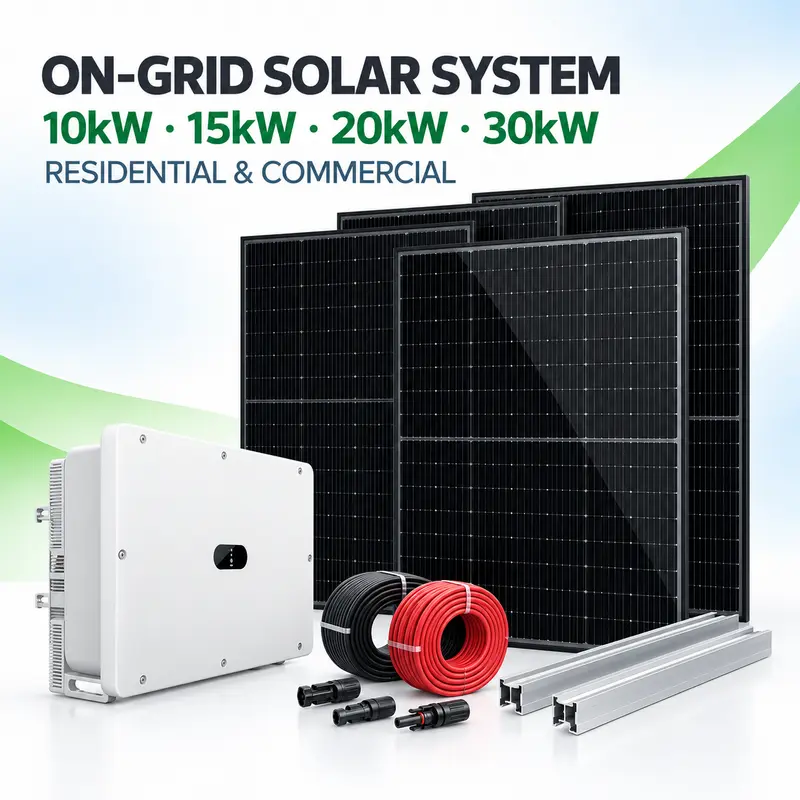
10kW 15kW 20kW 30kW On-Grid Solar System

The 10kW–30kW on-grid solar system combines monocrystalline solar panels, a grid-tied inverter, mounting structures, PV cables and electrical protection devices for residential and small commercial solar projects.

Available capacities include 10kW, 15kW, 20kW and 30kW. Solar panel quantity, inverter model, phase type and mounting system are configured according to the local grid standard, installation area and project requirements.

System Capacity 10kW / 15kW / 20kW / 30kW
System Type On-Grid / Grid-Tied Solar System
Solar Panel Monocrystalline PV Module
Inverter Single-Phase or Three-Phase On-Grid Inverter
Output Frequency 50Hz / 60Hz
Mounting Option Roof / Ground
Battery Storage Not Included in Standard Configuration

New products

10kW 15kW 20kW 30kW On-Grid Solar System

The 10kW–30kW on-grid solar system is a configurable grid-connected photovoltaic solution for homes, villas, offices, retail stores, workshops and other small commercial facilities. Available system capacities include 10kW, 15kW, 20kW and 30kW.

The system converts solar energy into AC electricity for local loads. When solar generation is greater than the building’s consumption, surplus electricity may be exported to the utility grid where local regulations and grid agreements permit.

Each project can be configured with monocrystalline solar panels, a matched grid-tied inverter, roof or ground mounting structures, PV cables, connectors and AC/DC protection devices.

Key Features

  • 10kW–30kW capacity range: Four system sizes for residential and small commercial applications.
  • Direct grid connection: Solar electricity supplies local loads while the utility grid provides power when solar generation is insufficient.
  • No standard battery requirement: A conventional on-grid system operates without battery storage.
  • Single-phase or three-phase options: The inverter is selected according to the local electrical system.
  • Monocrystalline solar panels: Panel wattage and quantity are selected according to the required PV capacity.
  • Integrated MPPT: The grid-tied inverter tracks the solar array’s maximum power point.
  • Remote monitoring: WiFi, Ethernet, RS485 or app monitoring may be available with the selected inverter.
  • Flexible mounting: Roof-mounted and ground-mounted structures are available.
  • Complete project supply: Inverter, panels, cables, connectors, mounting and protection devices can be included.

How an On-Grid Solar System Works

During daylight hours, the solar panels generate DC electricity. The grid-tied inverter converts the DC power into AC electricity that matches the voltage, frequency and phase of the utility grid.

The building uses solar power first. If solar generation is lower than the current load, the utility grid supplies the remaining electricity. If solar generation exceeds the local load, surplus electricity may be exported through an approved bidirectional meter.

Export permission, feed-in tariffs, net metering rules and inverter certification vary by country and utility company. These requirements must be confirmed before selecting the inverter and finalizing the system design.

Important Backup Power Information

A standard on-grid solar system does not provide backup electricity during a utility outage. For grid safety, the grid-tied inverter normally stops operating when it detects that the utility grid has failed.

If backup power is required, a hybrid inverter and battery storage system should be selected instead. The required battery capacity must then be calculated according to the essential loads and backup duration.

Standard System Components

  • Monocrystalline solar panels
  • Single-phase or three-phase grid-tied inverter
  • Solar panel roof or ground mounting structure
  • PV cable and solar connectors
  • DC isolation switch
  • AC circuit breaker
  • AC and DC surge protection devices
  • Optional AC/DC distribution or combiner box
  • Optional WiFi or remote monitoring device
  • Optional bidirectional energy meter

Technical Specifications

System Option 10kW 15kW 20kW 30kW
System Information
Rated System Power 10kW 15kW 20kW 30kW
System Type On-Grid / Grid-Tied Solar Power System
Typical Application Large Home or Small Office Villa, Office or Retail Store Small Commercial Facility Workshop or Commercial Building
System Configuration Customized According to Grid Standard and Installation Site
Solar Array Configuration
Solar Panel Type Monocrystalline PV Module
PV Array Capacity Matched to the Selected Inverter and Project Design
Solar Panel Wattage Selected According to Project Availability and Installation Area
Solar Panel Quantity Calculated According to Panel Wattage and Required DC Capacity
Panel Connection String Configuration Designed According to Inverter MPPT Limits
Inverter Configuration
Inverter Type On-Grid String Inverter
Rated AC Output 10kW 15kW 20kW 30kW
Phase Type Single Phase or Three Phase, Depending on Model and Grid Standard
Typical AC Voltage 220–240V Single Phase or 380–415V Three Phase
Output Frequency 50Hz / 60Hz
Solar Controller Integrated MPPT
Grid Export Subject to Utility Approval and Local Regulations
Monitoring WiFi / Ethernet / RS485 / App Option, Model Dependent
Mounting and Installation
Mounting Type Roof-Mounted or Ground-Mounted
Roof Type Tile, Metal, Flat Roof or Project-Specific Structure
Mounting Material Anodized Aluminum and Stainless-Steel Fasteners
Mounting Design Customized According to Roof or Ground Conditions
Cables and Electrical Protection
PV Cable 4 mm² / 6 mm² or Project-Specific Selection
Solar Connector MC4-Compatible Connector
DC Isolation Configured According to PV String Design
AC Circuit Protection Selected According to Inverter Output Current
Surge Protection AC and DC SPD According to Project Requirements
Distribution Box Optional AC/DC Distribution or Combiner Box
Battery and Backup
Battery Included No, Not Included in the Standard On-Grid Configuration
Backup During Grid Outage Not Available with a Standard Grid-Tied Inverter
Battery Upgrade Select a Hybrid Solar System if Battery Backup Is Required
Ordering Information
Minimum Order Quantity 1 Complete System
System Customization Panel, Inverter, Mounting, Cable and Protection Configuration
Certification Confirmed According to the Selected Components and Destination Market
Warranty Confirmed Separately for the Solar Panels, Inverter and Accessories
Final Bill of Materials Issued After Project Requirements Are Confirmed

How to Select the Correct System Size

The correct system capacity should be selected according to annual electricity consumption, daytime load, available installation area and local solar resources. A larger inverter does not always produce more useful energy if the solar array or installation area is insufficient.

Please provide the following information before requesting a final configuration:

  • Installation country and project address
  • Monthly or annual electricity consumption
  • Electricity bills or daytime load profile
  • Single-phase or three-phase grid supply
  • Grid voltage and frequency
  • Available roof or ground installation area
  • Roof type, orientation and tilt angle
  • Whether grid export is permitted
  • Preferred solar panel or inverter brand

Recommended Applications

  • Large residential properties
  • Villas and apartment buildings
  • Offices and retail stores
  • Schools and community buildings
  • Small factories and workshops
  • Warehouses and agricultural buildings
  • Commercial rooftops with high daytime electricity consumption

Project Design and Quotation

This product is supplied as a customized on-grid solar system rather than a fixed kit. Solar panel quantity, inverter model, mounting structure, cable length and protection devices may change according to the project.

For an accurate quotation, please provide the installation location, electricity consumption, grid voltage, phase type, roof information and preferred system capacity. We will prepare a recommended configuration and detailed bill of materials.

FAQ

What is included in the on-grid solar system?

The system can include solar panels, a grid-tied inverter, mounting structures, PV cables, connectors, isolation switches and AC/DC protection devices. The final scope is confirmed in the quotation.

Does the system include a battery?

No. A standard on-grid system normally operates without battery storage. A hybrid solar system should be selected if battery backup is required.

Will the system work during a grid outage?

No. A standard grid-tied inverter normally shuts down during a utility outage for grid safety. Backup operation requires a compatible hybrid inverter and battery.

Can surplus solar electricity be exported?

Yes, where local regulations, the utility company and the selected inverter permit grid export. A bidirectional meter and grid connection approval may be required.

How many solar panels are included?

The quantity depends on the selected panel wattage, inverter MPPT limits, DC/AC ratio and available installation area.

Should I select a single-phase or three-phase inverter?

The inverter must match the property’s electrical supply and local grid requirements. Larger commercial systems commonly use three-phase inverters.

Which system size should I select?

System size should be calculated using electricity consumption, daytime load, available installation area and local solar irradiation.

Can the system be installed on the ground?

Yes. Roof-mounted and ground-mounted structures are available. The final structure is designed according to site conditions and wind and snow load requirements.

Does the complete system have one certification?

No. Certifications apply to individual solar panels, inverters and electrical components. Required certificates should be confirmed for the destination market before ordering.
Leave a Message

Tell us what product you need and include the voltage, capacity, quantity or application if available. We will contact you as soon as possible.

Contact Form Demo

10kW 15kW 20kW 30kW On-Grid Solar System

The 10kW–30kW on-grid solar system is a configurable grid-connected photovoltaic solution for homes, villas, offices, retail stores, workshops and other small commercial facilities. Available system capacities include 10kW, 15kW, 20kW and 30kW.

The system converts solar energy into AC electricity for local loads. When solar generation is greater than the building’s consumption, surplus electricity may be exported to the utility grid where local regulations and grid agreements permit.

Each project can be configured with monocrystalline solar panels, a matched grid-tied inverter, roof or ground mounting structures, PV cables, connectors and AC/DC protection devices.

Key Features

  • 10kW–30kW capacity range: Four system sizes for residential and small commercial applications.
  • Direct grid connection: Solar electricity supplies local loads while the utility grid provides power when solar generation is insufficient.
  • No standard battery requirement: A conventional on-grid system operates without battery storage.
  • Single-phase or three-phase options: The inverter is selected according to the local electrical system.
  • Monocrystalline solar panels: Panel wattage and quantity are selected according to the required PV capacity.
  • Integrated MPPT: The grid-tied inverter tracks the solar array’s maximum power point.
  • Remote monitoring: WiFi, Ethernet, RS485 or app monitoring may be available with the selected inverter.
  • Flexible mounting: Roof-mounted and ground-mounted structures are available.
  • Complete project supply: Inverter, panels, cables, connectors, mounting and protection devices can be included.

How an On-Grid Solar System Works

During daylight hours, the solar panels generate DC electricity. The grid-tied inverter converts the DC power into AC electricity that matches the voltage, frequency and phase of the utility grid.

The building uses solar power first. If solar generation is lower than the current load, the utility grid supplies the remaining electricity. If solar generation exceeds the local load, surplus electricity may be exported through an approved bidirectional meter.

Export permission, feed-in tariffs, net metering rules and inverter certification vary by country and utility company. These requirements must be confirmed before selecting the inverter and finalizing the system design.

Important Backup Power Information

A standard on-grid solar system does not provide backup electricity during a utility outage. For grid safety, the grid-tied inverter normally stops operating when it detects that the utility grid has failed.

If backup power is required, a hybrid inverter and battery storage system should be selected instead. The required battery capacity must then be calculated according to the essential loads and backup duration.

Standard System Components

  • Monocrystalline solar panels
  • Single-phase or three-phase grid-tied inverter
  • Solar panel roof or ground mounting structure
  • PV cable and solar connectors
  • DC isolation switch
  • AC circuit breaker
  • AC and DC surge protection devices
  • Optional AC/DC distribution or combiner box
  • Optional WiFi or remote monitoring device
  • Optional bidirectional energy meter

Technical Specifications

System Option 10kW 15kW 20kW 30kW
System Information
Rated System Power 10kW 15kW 20kW 30kW
System Type On-Grid / Grid-Tied Solar Power System
Typical Application Large Home or Small Office Villa, Office or Retail Store Small Commercial Facility Workshop or Commercial Building
System Configuration Customized According to Grid Standard and Installation Site
Solar Array Configuration
Solar Panel Type Monocrystalline PV Module
PV Array Capacity Matched to the Selected Inverter and Project Design
Solar Panel Wattage Selected According to Project Availability and Installation Area
Solar Panel Quantity Calculated According to Panel Wattage and Required DC Capacity
Panel Connection String Configuration Designed According to Inverter MPPT Limits
Inverter Configuration
Inverter Type On-Grid String Inverter
Rated AC Output 10kW 15kW 20kW 30kW
Phase Type Single Phase or Three Phase, Depending on Model and Grid Standard
Typical AC Voltage 220–240V Single Phase or 380–415V Three Phase
Output Frequency 50Hz / 60Hz
Solar Controller Integrated MPPT
Grid Export Subject to Utility Approval and Local Regulations
Monitoring WiFi / Ethernet / RS485 / App Option, Model Dependent
Mounting and Installation
Mounting Type Roof-Mounted or Ground-Mounted
Roof Type Tile, Metal, Flat Roof or Project-Specific Structure
Mounting Material Anodized Aluminum and Stainless-Steel Fasteners
Mounting Design Customized According to Roof or Ground Conditions
Cables and Electrical Protection
PV Cable 4 mm² / 6 mm² or Project-Specific Selection
Solar Connector MC4-Compatible Connector
DC Isolation Configured According to PV String Design
AC Circuit Protection Selected According to Inverter Output Current
Surge Protection AC and DC SPD According to Project Requirements
Distribution Box Optional AC/DC Distribution or Combiner Box
Battery and Backup
Battery Included No, Not Included in the Standard On-Grid Configuration
Backup During Grid Outage Not Available with a Standard Grid-Tied Inverter
Battery Upgrade Select a Hybrid Solar System if Battery Backup Is Required
Ordering Information
Minimum Order Quantity 1 Complete System
System Customization Panel, Inverter, Mounting, Cable and Protection Configuration
Certification Confirmed According to the Selected Components and Destination Market
Warranty Confirmed Separately for the Solar Panels, Inverter and Accessories
Final Bill of Materials Issued After Project Requirements Are Confirmed

How to Select the Correct System Size

The correct system capacity should be selected according to annual electricity consumption, daytime load, available installation area and local solar resources. A larger inverter does not always produce more useful energy if the solar array or installation area is insufficient.

Please provide the following information before requesting a final configuration:

  • Installation country and project address
  • Monthly or annual electricity consumption
  • Electricity bills or daytime load profile
  • Single-phase or three-phase grid supply
  • Grid voltage and frequency
  • Available roof or ground installation area
  • Roof type, orientation and tilt angle
  • Whether grid export is permitted
  • Preferred solar panel or inverter brand

Recommended Applications

  • Large residential properties
  • Villas and apartment buildings
  • Offices and retail stores
  • Schools and community buildings
  • Small factories and workshops
  • Warehouses and agricultural buildings
  • Commercial rooftops with high daytime electricity consumption

Project Design and Quotation

This product is supplied as a customized on-grid solar system rather than a fixed kit. Solar panel quantity, inverter model, mounting structure, cable length and protection devices may change according to the project.

For an accurate quotation, please provide the installation location, electricity consumption, grid voltage, phase type, roof information and preferred system capacity. We will prepare a recommended configuration and detailed bill of materials.

FAQ

What is included in the on-grid solar system?

The system can include solar panels, a grid-tied inverter, mounting structures, PV cables, connectors, isolation switches and AC/DC protection devices. The final scope is confirmed in the quotation.

Does the system include a battery?

No. A standard on-grid system normally operates without battery storage. A hybrid solar system should be selected if battery backup is required.

Will the system work during a grid outage?

No. A standard grid-tied inverter normally shuts down during a utility outage for grid safety. Backup operation requires a compatible hybrid inverter and battery.

Can surplus solar electricity be exported?

Yes, where local regulations, the utility company and the selected inverter permit grid export. A bidirectional meter and grid connection approval may be required.

How many solar panels are included?

The quantity depends on the selected panel wattage, inverter MPPT limits, DC/AC ratio and available installation area.

Should I select a single-phase or three-phase inverter?

The inverter must match the property’s electrical supply and local grid requirements. Larger commercial systems commonly use three-phase inverters.

Which system size should I select?

System size should be calculated using electricity consumption, daytime load, available installation area and local solar irradiation.

Can the system be installed on the ground?

Yes. Roof-mounted and ground-mounted structures are available. The final structure is designed according to site conditions and wind and snow load requirements.

Does the complete system have one certification?

No. Certifications apply to individual solar panels, inverters and electrical components. Required certificates should be confirmed for the destination market before ordering.
Leave a Message

Tell us what product you need and include the voltage, capacity, quantity or application if available. We will contact you as soon as possible.

Contact Form Demo