


What Is the Core Working Principle of Low Voltage LiFePO4 Batteries and Why Are They Preferred for Low-Voltage Energy Storage?
Low voltage lithium iron phosphate batteries have become the mainstream replacement for lead-acid batteries in off-grid solar, RVs, yachts, home energy storage, backup power for base stations, UPS and small commercial standby power systems. Many distributors, installers and end users struggle with voltage options at the first stage of selection.
A single LiFePO4 cell carries a nominal voltage of 3.2V, with a full charge voltage of 3.65V and discharge cut-off voltage of 2.5V. Battery packs are assembled by connecting multiple cells in series to form standard 12V, 24V and 51.2V units.
The material delivers outstanding safety performance. Its thermal runaway temperature exceeds 270°C, so it is far less likely to burn or explode compared with NMC lithium batteries. This feature makes it ideal for enclosed spaces such as RV cabins, boat compartments and indoor residential storage systems. Premium grade A cells can reach over 4000 cycles at 80% DOD, while traditional lead-acid batteries only support 300 to 500 cycles. LiFePO4 batteries allow 80% deep discharge, much higher than the 50% safe limit for lead-acid products. They also feature low self-discharge rate and zero memory effect, which guarantees stable performance for long-term standby power scenarios.
Still, users need to understand its drawbacks. LiFePO4 suffers obvious capacity drop below 0°C and requires a BMS with heating function for cold environments. Its energy density is lower than ternary lithium, so the same capacity comes with heavier weight and brings extra load pressure for mobile vehicles.
What Applications Fit 12V LiFePO4 Batteries and How Can You Avoid High Current Loss and Parallel Connection Risks?
A standard 12V LiFePO4 pack adopts a 4S configuration with a nominal voltage of 12.8V, widely known as the 12V version in the industry. It is one of the earliest popular low-voltage lithium solutions and commonly used in RVs, small boats, mini off-grid solar systems, monitoring backup power, portable power stations and agricultural equipment power supply.
One key rule users must remember: for the same power output, lower voltage means higher DC current. For example, a 3kW load will create a DC current close to 250A in a 12V system. Heavy current will force users to adopt thicker cables, bring terminal overheating, large voltage drop and raise costs for fuses and circuit breakers. Power loss becomes severe when the wiring distance is long.
This model works well for low-power loads and short wiring runs, including small RV builds, small vessels, backup power and compact solar setups. It is not recommended for continuous loads above 5kW, long-distance multi-battery parallel systems or whole-house residential storage.
Before purchase, check whether the continuous discharge current of the BMS matches the peak load current. It is also necessary to confirm cell balancing support, low-temperature heating function and enclosure IP rating. Many cheap 12V batteries have overrated BMS current, which leads to unexpected shutdown under heavy load and causes frequent after-sales issues.
What Improvements Does a 24V LiFePO4 Battery Bring Over a 12V Unit and Which Projects Should Prioritize 24V Models?
The 24V LiFePO4 battery uses an 8S cell configuration with a nominal voltage of 25.6V, generally referred to as 24V in the market. It acts as an upgraded alternative to the 12V solution. The current is cut in half for the same power level, which greatly reduces heat generation, cable loss and wiring expenditure.
With a 3kW load, the current on a 24V system stays at roughly 125A. This eases pressure on wires, copper bars and connection terminals. It is a popular choice for medium-sized RVs, caravans, mid-range yachts, small off-grid solar for homestays and solar-powered irrigation systems.
Many buyers wonder if they can connect two separate 12V batteries in series to replace a single 24V battery. It is technically feasible but carries high risks. Independent BMS boards do not synchronize protection triggers perfectly. One pack may shut down in advance, creating large cell voltage differences and accelerating battery degradation. For stable engineering deployment, choose an integrated factory 8S 24V battery with one unified BMS managing all cells.
The 24V platform suits systems between 3kW and 6kW. For continuous power demand higher than 6kW, installers usually recommend upgrading to the 48V / 51.2V platform.
Are 48V and 51.2V LiFePO4 Batteries the Same Product and What Compatibility Traps Hide Behind the Mixed Naming Convention?
This is the most frequently asked technical question from procurement teams. Buyers often see batteries marked 48V and 51.2V while their inverters are labelled 48V, and they are confused about cross-compatibility.
Most mainstream 51.2V LiFePO4 packs adopt a 16S series design, 16 multiplied by 3.2V equals 51.2V nominal voltage. The term 48V is inherited from old lead-acid systems and describes the system class instead of the actual cell stack voltage. The full charge voltage of a 16S pack reaches 58.4V, fitting the voltage window of most 48V hybrid inverters, solar charge controllers and telecom power supplies. That is why it is grouped into the 48V low voltage category.
A critical warning: some manufacturers produce 15S packs labelled 48V. Their voltage curve and charging cut-off point differ completely from 16S 51.2V batteries. They cannot be paralleled directly and may not work with the same inverter. Never select batteries only by the “48V” title. Always verify the cell series count and charging voltage parameters before ordering.
The 51.2V solution generates the lowest current at the same power level and minimizes cable power loss. It is the dominant low-voltage storage option for residential solar, villa energy storage, small commercial storage, telecom backup and multi-pack parallel expansion. For a 5kW load, the DC current on a 51.2V system stays below 100A, delivering better thermal control and parallel stability than 12V and 24V alternatives.
How Do You Match Voltage Selection With Loads, Inverters and Solar Controllers and What Is the Clear Selection Logic?
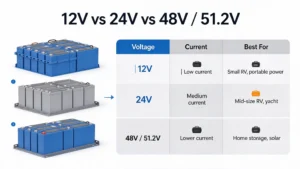
Many buyers still struggle after reading technical parameters. The core is to evaluate load power, wiring distance and future expansion plans together.When selecting Low Voltage LiFePO4 Batteries, you need to balance current demand, cable loss and future expansion needs.
Follow this decision sequence:
- Load power: consider 12V for systems below 3kW; 24V for 3kW to 6kW; 51.2V for systems above 6kW, home storage and projects requiring later expansion.
- Wiring length: longer DC cables require higher voltage to reduce voltage drop and heat.
- Inverter compatibility: the inverter voltage rating sets a hard limit. If your inverter is built for 48V systems, select 16S 51.2V batteries and double-check charging parameters.
- Expansion plan: pick standard 51.2V batteries if you plan to add more packs later. Most models support parallel connection with communication balancing.
- Low-temperature environment: no matter which voltage you choose, units installed outdoors in cold zones or unheated spaces must come with a heating BMS. Charging at sub-zero temperatures without heating will trigger lithium plating and permanently damage cells.
Avoid choosing low-voltage batteries just to cut upfront costs for high-power loads. Savings on battery purchase will be offset by higher cable, circuit breaker and maintenance costs, plus unexpected downtime.
Among BMS, Cell Grade, Balancing and Low-Temperature Protection, Which Metrics Decide Total Battery Lifespan?
Voltage is only a surface specification. BMS quality and cell grade create the biggest gap in battery performance and determine the user experience across 3 to 10 years. When buying Low Voltage LiFePO4 Batteries, you should never ignore these hidden specs. These details are often overlooked during sourcing.
It is common to see identical 12V 100Ah batteries with very different price tags. The difference comes from internal components.
- Cell grade: brand-new grade A cells, used B-grade cells and retired tier-2 cells show huge gaps in cycle life and consistency. Tier-2 cells carry a lower price but develop voltage drift quickly, making them unsuitable for long-term energy storage.
- BMS balancing type: passive balancing consumes excess power through resistors and fits small capacity packs. Active balancing transfers energy between cells and maintains stable voltage differences for large-capacity parallel systems, extending pack life.
- Protection accuracy: precise over-charge, over-discharge, over-current, short-circuit and temperature protection prevents fire and cell failure. Poor-quality BMS fails to respond in time or triggers false alarms.
- Communication options: RS485, CAN bus and Bluetooth monitoring are required for commercial and base station projects to track cell voltage, temperature and SOC remotely. Bluetooth is a convenient add-on for RV and home users to check battery status via mobile phones.
Many buyers only compare Ah capacity and ignore continuous discharge rating. A 12V 100Ah battery with a 50A continuous BMS performs very differently from the same capacity model with a 100A BMS. The continuous discharge rating must exceed the peak system current.
What Limits Apply to Parallel Expansion and Can Batteries With Different Voltages Be Paralleled Together?
System installers frequently ask whether they can add a new 24V or 51.2V battery to an existing 12V battery bank.
The clear answer is no. Batteries with different nominal voltage or different cell series counts must not be paralleled or casually connected in series. Mismatched units create large circulating current, disrupt BMS protection logic and destroy cells.
Safe parallel connection for Low Voltage LiFePO4 Batteries requires the same series count, same capacity, same model from the same brand, matched SOC and equal-length cables with identical resistance.Use factory-approved parallel models with dedicated communication cables. 12V packs support parallel connection but are usually limited to 4 units, as total current rises rapidly. 24V parallel setups work for medium systems but have limited scalability. The 16S 51.2V platform is the most mature parallel solution. Most residential storage batteries support 4 to 16 units in parallel for modular capacity expansion, making it the top choice for scalable low-voltage storage.
How to Evaluate Long-Term Maintenance Cost, Warranty and Certifications for Low-Voltage LiFePO4 Batteries and How to Avoid Low-Cost Pitfalls?
Every buyer cares about total cost of ownership. Cheap batteries may look attractive at first glance, but they can turn out expensive when you count replacement, labour and downtime losses.
Certifications are essential for export orders. CE, UN38.3 and MSDS documents are required for customs clearance.Domestic solar and telecom projects also demand valid test reports; uncertified batteries cannot be approved for site deployment.
Read warranty terms carefully. Many low-cost suppliers only cover the cells, while the BMS, wiring harness and enclosure are excluded from warranty coverage. Also distinguish between cycle-based warranty and fixed-year warranty.
Well-managed premium LiFePO4 batteries lose roughly 2% to 3% capacity each year. Degradation speeds up sharply under frequent cold charging, permanent full state of charge or continuous over-rate discharge.
Simple maintenance habits help extend service life. Check cell voltage balance regularly. If batteries will be stored for a long time, keep SOC between 40% and 60%. Avoid leaving packs at 100% SOC for extended idle periods.
Many low-priced products use exaggerated capacity labels, fake BMS current ratings and recycled cells. They often suffer severe voltage imbalance, BMS failure and fast capacity drop within one or two years. The total cost ends up much higher than trusted premium options.
How Do Different Users Choose Between 12V, 24V, 48V and 51.2V Low Voltage LiFePO4 Batteries?
- Small RVs, boats, portable power stations and low-power off-grid solar systems: 12V LiFePO4 is suitable.
- Medium RV conversions, mid-size yachts, small solar irrigation and homestay backup power: select 24V LiFePO4.
- Residential solar storage, villa storage, telecom base stations, small commercial storage and expandable systems: choose 51.2V (16S 48V-class) LiFePO4.
The core checklist before purchase includes cell series configuration, charging cut-off voltage, BMS continuous discharge rating, balancing function, low-temperature heating and inverter compatibility.
Choosing the right Low Voltage LiFePO4 Batteries is not simply about picking the largest capacity. Voltage selection is a trade-off between working current, power loss, wiring expense, system compatibility and expansion capability. Understanding the cell stack difference behind 12V, 24V, 48V and 51.2V helps you build stable, low-maintenance and long-lasting energy storage systems.