


Selecting a solar system for a real project requires more than choosing high-power solar panels. The system design needs to match electricity demand, grid availability, installation conditions, and future expansion requirements.
For example, a commercial building with a stable power grid may choose an On Grid Solar System to reduce electricity costs. A remote farm or industrial site without reliable grid access may need an Off Grid Solar System with battery storage. For projects that require both energy savings and backup power, Hybrid Solar Systems provide a more flexible option.
Understanding how different Solar Products & Systems work helps installers, distributors, and EPC companies select suitable configurations and avoid performance issues caused by improper system design.
What Components Are Included in a Complete Solar Products & Systems Solution?
A complete Solar Products & Systems solution includes more than photovoltaic modules. It usually combines solar panels, inverters, battery storage systems, and energy management equipment to generate, convert, store, and control electricity.
The main components include:
Solar Panels
Solar panels are responsible for converting sunlight into DC electricity.
The performance of photovoltaic modules directly affects the total energy output of the system. When designing a solar project, engineers need to consider factors such as sunlight conditions, installation angle, available installation space, and expected energy production.
Solar Inverters
Solar inverters convert DC electricity generated by solar panels into AC electricity for electrical loads.
Different solar applications require different inverter solutions. Grid-connected projects usually use on-grid inverters, while systems with battery storage require hybrid inverters that can manage solar power generation, battery charging, and grid interaction.
Battery Storage Systems
Battery storage allows solar energy to be stored and used when solar production is unavailable.
For example, during nighttime or grid outages, stored energy can continue supplying electricity to important loads.
Lithium battery technology is widely used in modern solar storage applications because of its long cycle life, high energy density, and reliable performance.
Energy Monitoring and Management Systems
Energy monitoring systems allow users to check solar production, electricity consumption, and battery status.
For commercial and industrial projects, accurate energy monitoring helps improve system operation and energy management efficiency.
How Do On Grid Solar Systems Work and When Are They Suitable?
On Grid Solar Systems are connected to the public electricity grid and are commonly used in areas with stable grid infrastructure.
During the daytime, solar panels generate electricity that can directly supply buildings or facilities. When solar production is higher than electricity demand, excess energy may be exported to the grid depending on local regulations.
Why Are On Grid Solar Systems Commonly Used for Commercial Projects?
Many businesses choose on-grid solar systems because reducing electricity costs is one of their main goals.
These systems are suitable for:
- Commercial buildings
- Factory rooftops
- Warehouses
- Office buildings
- Large-scale solar projects
The main advantages include:
- Lower initial investment compared with systems using batteries
- Simple system structure
- Easier installation and maintenance
- High solar energy utilization during daytime operation
However, traditional on-grid systems usually cannot provide backup power during grid failures because they must disconnect from the grid for safety reasons.
How Do Off Grid Solar Systems Provide Independent Power Supply?
Off Grid Solar Systems are designed for locations where grid electricity is unavailable or unreliable.
These systems usually include:
- Solar panels
- Off-grid inverter
- Battery storage system
- Energy management equipment
During the daytime, solar panels generate electricity and charge the battery. When solar power is unavailable, the stored energy supplies electricity to connected loads.
Where Are Off Grid Solar Systems Commonly Used?
Off-grid solutions are often used in:
- Remote farms
- Rural areas
- Mountain regions
- Communication stations
- Remote monitoring systems
- Emergency power applications
For these projects, system reliability and energy independence are usually more important than minimizing initial investment.
How Should Battery Capacity Be Selected for Off Grid Solar Systems?
Battery sizing directly affects the reliability of an off-grid solar system.
A battery that is too small may not provide enough power during cloudy days or nighttime operation, while an oversized battery may increase unnecessary project costs.
Engineers usually consider:
- Daily electricity consumption
- Required backup time
- Local weather conditions
- Load characteristics
- Future expansion requirements
How Do Hybrid Solar Systems Work With Battery Storage?
Hybrid Solar Systems combine solar generation, battery storage, and grid connection to provide a flexible energy solution.
Unlike traditional on-grid systems, hybrid systems can store excess solar energy and use it when needed.
A typical hybrid solar system operates as follows:
- Solar panels provide electricity during the day
- Extra solar energy charges the battery
- Battery storage supplies power when solar generation is low
- Grid electricity supports the system when additional power is required
Why Are Hybrid Solar Systems Suitable for Energy Storage Projects?
Hybrid Solar Systems are often selected for projects where both energy cost control and power reliability are important.
How Can Hybrid Systems Improve Energy Independence?
Battery storage allows users to reduce dependence on grid electricity and maintain power availability during outages.
This makes hybrid solutions suitable for:
- Residential buildings
- Small businesses
- Commercial facilities
- Areas with unstable grid conditions
How Can Hybrid Systems Increase Solar Energy Utilization?
Without storage, excess solar energy may not always be fully used.
Hybrid systems store surplus electricity and release it when energy demand increases, improving the overall utilization of solar power.
Can Hybrid Systems Support Future Expansion?
Many projects may start with solar generation and add additional battery capacity later.
A properly designed hybrid system allows easier expansion as electricity demand grows.
How Should Customers Choose Between On Grid Solar Systems, Off Grid Solar Systems and Hybrid Solar Systems?
The suitable system depends on the project environment and electricity requirements.
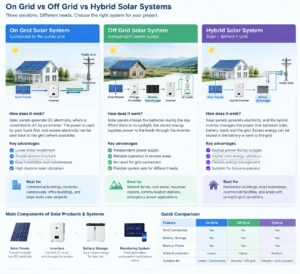
Comparison of different Solar Products & Systems including On Grid Solar Systems, Off Grid Solar Systems and Hybrid Solar Systems
| Project Requirements | Recommended Solution |
|---|---|
| Stable grid connection and focus on reducing electricity bills | On Grid Solar Systems |
| No grid access or unreliable electricity supply | Off Grid Solar Systems |
| Need backup power and energy management | Hybrid Solar Systems |
Before selecting a solar system, customers should evaluate several factors.
What Is the Local Grid Condition?
Grid availability is one of the most important factors.
Projects with stable electricity networks are usually suitable for on-grid solutions, while remote locations may require independent solar systems.
How Much Electricity Does the Project Require?
System capacity should be calculated based on actual energy consumption rather than selecting equipment only based on maximum power output.
Is Battery Backup Necessary?
If continuous electricity supply is important, adding battery storage can improve system reliability and reduce the impact of power interruptions.
What Factors Should Be Considered When Designing Solar Products & Systems?
A successful solar project requires proper matching between all system components.
Important factors include:
- Compatibility between solar panels, inverters, and batteries
- Battery safety and cycle life
- Installation environment
- Maintenance requirements
- Local technical standards
- Future expansion possibilities
For installers, distributors, and EPC companies, selecting suitable Solar Products & Systems and reliable equipment suppliers can improve project performance and long-term customer value.
Why Is Proper Solar System Design Important for Long-Term Operation?
Different applications require different solar configurations. A factory rooftop project, a remote agricultural system, and a backup power solution all have different technical requirements.
By understanding the differences between Hybrid Solar Systems, Off Grid Solar Systems, and On Grid Solar Systems, customers can choose a more suitable solution for their specific applications.
A properly designed Solar Products & Systems solution should provide reliable energy output, efficient operation, and flexibility for future system expansion.