


A 10MWh BESS (Battery Energy Storage System) project requires careful consideration of container configuration, safety, transportation, and long-term operating costs. For a large-scale solar PV and battery energy storage project, should the system be integrated into one 40ft container or split into two 20ft containers?
Which configuration makes more sense for safety, transportation, cost, and long-term operation?
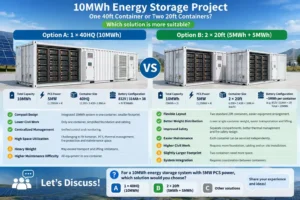
Recently, our team at Solarayen reviewed a procurement specification for a large-scale solar PV and battery energy storage project.
One particular requirement caught our attention: a 10MWh battery energy storage system integrated into a single 40HQ container.
After reviewing the initial specifications, we started exploring whether splitting the system into two 5MWh battery containers could offer a more practical alternative.
Here’s our preliminary analysis.
Option A: 1 × 40HQ Container — 10MWh
Original project specifications:
– Total battery capacity: 10MWh
– Container: 1 × 40HQ
– Dimensions: 12.192 × 2.438 × 2.896m
– Battery configuration: 832V / 314Ah × 38
– BMS: Three-level architecture (BAU, BCU, BMU)
– PCS: 1,250kW × 4 = 5MW
Based on the provided battery parameters:
832V × 314Ah × 38 ≈ 9.93MWh
The calculated nominal battery capacity is close to the 10MWh requirement.
However, meeting the capacity requirement on paper doesn’t necessarily guarantee a practical container layout.
Several engineering factors need further evaluation:
1. Space utilization
Can all battery racks, thermal management equipment, fire protection systems, and auxiliary components fit within a single 40HQ container while maintaining adequate maintenance access?
2. Total system weight
A 10MWh battery system represents a substantial weight. Structural load capacity, transportation restrictions, and lifting requirements must be carefully evaluated.
3. Thermal management and safety
Higher energy density requires careful consideration of cooling performance, fire protection, system isolation, and maintenance accessibility.
Option B: 2 × 20ft Containers — 5MWh Each
As an alternative, we are considering a modular configuration consisting of two dedicated 20ft battery energy storage containers.
Proposed configuration:
– Container quantity: 2 × 20ft
– Battery capacity: Approximately 5MWh per container
– Total capacity: Approximately 10MWh
– Target PCS power: 5MW
– Integrated BMS, thermal management, fire protection, and EMS
The availability and technical feasibility of a 5MWh configuration in each 20ft container would need to be verified with the system manufacturer.
Potential advantages include:
– More flexible equipment arrangement
– Lower weight per container
– Separate thermal management and fire protection zones
– Potentially easier transportation, lifting, and maintenance
However, the modular configuration may also require additional foundations, interconnection cabling, installation work, and system coordination.
Comparing Two Container Configurations for a 10MWh BESS
For a 10MWh BESS project, the container configuration should be evaluated based on safety, transportation, installation, and lifecycle costs.
| Key Factor | 1 × 40HQ Container | 2 × 20ft Containers |
|---|---|---|
| Total Capacity | 10MWh | 10MWh |
| Container Quantity | 1 | 2 |
| Target PCS Power | 5MW | 5MW |
| Equipment Layout | Centralized | Modular |
| Transportation | Heavier single unit | Two separate units |
| Thermal Management | Centralized design | Separate container systems |
| Maintenance | Depends on internal layout | Potentially more flexible |
| Civil & Electrical Work | Potentially fewer connections | Additional interconnections |
Neither option should be considered superior without a detailed technical and commercial evaluation.
Ultimately, the best solution depends on the actual battery configuration, system weight, safety requirements, installation conditions, and total project cost.
Now We’d Like to Hear From the Industry
For a 10MWh BESS project with 5MW PCS power, which configuration would you recommend?
A.One 40HQ container integrating 10MWh
B.Two 20ft containers, each providing 5MWh
C.Another configuration using standardized battery storage containers
From your experience, which approach offers the best balance of:
– Safety and reliability
– Transportation and installation
– Capital expenditure (CAPEX)
– Long-term operation and maintenance (O&M)
We’d especially welcome insights from BESS manufacturers, EPC contractors, electrical engineers, and energy storage system integrators.
A successful BESS project isn’t just about achieving the required capacity. It’s about delivering a safe, reliable, practical, and cost-effective system throughout its operational life.
We look forward to hearing your technical perspectives.
Choosing the right BESS configuration requires balancing technical performance, project requirements, installation conditions, and long-term operating costs.
Solarayen LiFePO4 Battery & Energy Storage Solutions