


As solar energy and energy storage systems continue to develop, lithium iron phosphate (LiFePO4) batteries are increasingly used in residential, commercial, industrial, and off-grid energy storage applications. At the heart of these battery systems are LiFePO4 battery cells, which determine much of the battery pack’s capacity, voltage, current capability, size, and overall performance.
For battery pack manufacturers, system integrators, distributors, and energy storage project developers, selecting the right cell requires more than simply comparing capacity and price. Nominal voltage, rated capacity, C-rate, internal resistance, temperature range, cell consistency, and series-parallel configuration all need to be considered.
So, how should you evaluate LiFePO4 battery cells for an energy storage project?
This practical guide explains the most important technical parameters and provides useful calculations to help buyers and engineers make better cell-selection decisions.
What Are LiFePO4 Battery Cells and How Do They Work?
LiFePO4 battery cells, also called lithium iron phosphate battery cells, are rechargeable lithium-ion cells that use lithium iron phosphate as the cathode material.
A typical cell consists of a positive electrode, negative electrode, separator, electrolyte, and current collectors. During charging and discharging, lithium ions move between the electrodes through the electrolyte, while electrons flow through the external circuit.
One of the most commonly referenced characteristics of LiFePO4 chemistry is its nominal cell voltage of approximately 3.2V. Multiple cells can then be connected in series and parallel to create a battery with the voltage and capacity required by a particular application.
For example, connecting 16 cells in series gives a nominal voltage of:
16 × 3.2V = 51.2V
This is why 51.2V-class battery systems are commonly built using 16 LiFePO4 cells connected in series.
However, nominal voltage is only one part of the cell specification. The actual operating voltage changes with state of charge, charging conditions, load, temperature, and other factors.
For battery manufacturers, the individual cell is the basic building block of the final battery pack. Therefore, cell quality and consistency can have a significant effect on the performance of the completed battery system.
What Are the Key Specifications of LiFePO4 Battery Cells?
When comparing cells from different suppliers, it is important to look beyond the advertised capacity.
The main specifications that engineers and buyers should review include:
- Nominal voltage
- Rated capacity
- Charge voltage
- Discharge cut-off voltage
- Maximum continuous charge current
- Maximum continuous discharge current
- Internal resistance
- Operating temperature
- Cycle-life test conditions
- Dimensions
- Weight
- Cell consistency
Nominal Voltage
A typical LiFePO4 cell has a nominal voltage of around 3.2V.
When cells are connected in series, the voltage increases according to the number of cells.
For example:
8S = 25.6V nominal
16S = 51.2V nominal
24S = 76.8V nominal
The exact voltage limits for charging and discharging must always be taken from the manufacturer’s datasheet.
Rated Capacity
Capacity is normally expressed in ampere-hours (Ah).
A 100Ah cell, for example, has a rated capacity of 100Ah under specified test conditions.
However, the actual usable capacity of a complete battery system can differ from the rated capacity because of discharge limits, temperature, efficiency, battery management settings, and other operating conditions.
Internal Resistance
Internal resistance affects voltage drop and heat generation when current flows through the cell.
A simplified relationship is:
Voltage Drop = Current × Internal Resistance
This means that internal resistance becomes particularly important when a battery system operates at high current.
For battery pack manufacturers, consistency between cells can be just as important as the absolute resistance value.
Operating Temperature
Temperature can influence charging performance, discharge capability, efficiency, and long-term degradation.
Therefore, buyers should check the manufacturer’s specified:
- Charging temperature range
- Discharging temperature range
- Storage temperature range
A cell should be selected according to the actual installation environment rather than assuming that all LiFePO4 cells have identical temperature characteristics.
How Do You Calculate LiFePO4 Battery Cell Capacity and Energy?
Ah tells you the electrical capacity of a cell, but it does not directly represent the amount of stored energy.
To estimate nominal energy, use:
Energy (Wh) = Voltage (V) × Capacity (Ah)
For a 3.2V 100Ah LiFePO4 cell:
3.2V × 100Ah = 320Wh
For a 3.2V 280Ah cell:
3.2V × 280Ah = 896Wh
For a 3.2V 314Ah cell:
3.2V × 314Ah = 1,004.8Wh
This calculation is useful for estimating the nominal energy of individual cells.
For a complete battery system, however, usable energy is more complicated.
For example, a 51.2V 100Ah battery has nominal energy of:
51.2V × 100Ah = 5.12kWh
But the energy actually available to the load depends on the battery’s usable depth of discharge, inverter efficiency, operating temperature, system losses, and battery management strategy.
This distinction is important when sizing batteries for solar energy storage or backup applications.
How Do You Choose Between 100Ah, 280Ah and 314Ah LiFePO4 Cells?
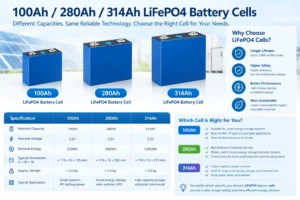
Different energy storage projects have different requirements, so there is no single cell capacity that is suitable for every battery design.
The choice should be based on the target system capacity, voltage, current, physical dimensions, manufacturing architecture, and application.
When Are 100Ah LiFePO4 Cells Suitable?
100Ah LiFePO4 cells can provide flexibility for battery pack designs where modularity and manageable cell dimensions are important.
For example, a 16S battery using 100Ah cells provides:
16 × 3.2V = 51.2V
and:
51.2V × 100Ah = 5.12kWh nominal energy
If two identical strings are connected in parallel, the configuration becomes approximately:
51.2V 200Ah
with nominal energy of:
51.2V × 200Ah = 10.24kWh
This type of configuration can be useful when a battery manufacturer wants to scale capacity through parallel connections.
When Are 280Ah LiFePO4 Cells Suitable?
280Ah LiFePO4 cells provide considerably more capacity per individual cell.
For a 16S configuration:
51.2V × 280Ah = 14.34kWh nominal energy
Using higher-capacity cells can reduce the number of parallel strings required to reach a target system capacity.
This may simplify the battery architecture by reducing the number of cell interconnections and potentially improving space utilization.
However, the physical size, current requirements, thermal design, and manufacturing process should also be evaluated.
When Are 314Ah LiFePO4 Cells Suitable?
314Ah LiFePO4 cells provide approximately 1kWh of nominal energy based on a 3.2V nominal voltage.
For a 16S battery:
51.2V × 314Ah ≈ 16.08kWh nominal energy
Higher-capacity cells can be attractive for larger energy storage systems because fewer parallel strings may be required.
However, the best cell is not necessarily the cell with the highest Ah rating. Engineers should evaluate the complete system architecture and compare capacity, dimensions, current capability, thermal requirements, and cost.
What Is C-Rate and How Does It Affect Battery Performance?
C-rate describes charging or discharging current relative to the rated capacity of a battery cell.
For a 100Ah cell:
1C = 100A
0.5C = 50A
0.2C = 20A
For a 280Ah cell:
1C = 280A
0.5C = 140A
For a 314Ah cell:
1C = 314A
These are mathematical relationships. The actual allowable current must always be determined from the cell manufacturer’s specifications.
Why does C-rate matter?
Because charging and discharging at different current levels can affect heat generation, voltage behavior, efficiency, and battery aging.
For example, a battery system designed for high-power operation may require cells with higher continuous discharge capability than a system designed primarily for long-duration energy storage.
Therefore, a buyer should not compare cells only by Ah capacity.
A better evaluation considers:
Capacity + C-rate + Voltage + Internal Resistance + Temperature + Application
Together, these parameters provide a much clearer picture of whether a particular cell is suitable for the intended battery system.
Why Are Cell Consistency and Internal Resistance Important?
When hundreds or even thousands of cells are assembled into a battery system, small differences between individual cells can become increasingly important.
Two cells with the same nominal capacity may still have differences in:
- Actual capacity
- Open-circuit voltage
- Internal resistance
- State of charge
- Self-discharge characteristics
This is why cell matching is an important part of battery manufacturing.
Capacity Consistency
If cells with significantly different capacities are connected together, the lower-capacity cells may reach their voltage limits earlier during charging or discharging.
This can affect the usable capacity of the entire battery pack.
Resistance Consistency
Differences in internal resistance can cause different voltage drops and heat generation when current flows through the cells.
The effect becomes more noticeable under higher current conditions.
Cell Matching
Before assembly, battery manufacturers may evaluate cells using parameters such as voltage, capacity and internal resistance.
The objective is to build a battery pack with cells that have sufficiently consistent characteristics for the intended application.
For B2B buyers, it is therefore useful to ask suppliers about their testing, matching, quality-control, and batch traceability procedures.
How Are LiFePO4 Cells Connected in Series and Parallel?
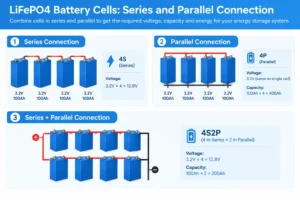
Series and parallel connections are fundamental concepts in battery pack design.
Series Connection
Series connection increases voltage.
For example:
16 × 3.2V = 51.2V
If 16 cells rated at 100Ah are connected in series, the resulting configuration is approximately:
51.2V 100Ah
The nominal energy is:
51.2V × 100Ah = 5.12kWh
Parallel Connection
Parallel connection increases capacity.
For example:
2 × 100Ah = 200Ah
Combining this with a 16S configuration gives:
16S2P 100Ah = 51.2V 200Ah
Nominal energy:
51.2V × 200Ah = 10.24kWh
Series-Parallel Configuration
Large battery systems often use both series and parallel connections.
The number of cells required depends on:
- Target system voltage
- Required capacity
- Maximum charge current
- Maximum discharge current
- Available installation space
- Battery management system architecture
- Thermal management
For this reason, cell selection should take place together with the overall battery design rather than as an isolated purchasing decision.
How Do You Choose a Reliable LiFePO4 Battery Cell Supplier?
For B2B buyers, choosing a battery cell supplier should involve both technical and commercial evaluation.
Can the Supplier Provide Complete Technical Data?
A reliable supplier should be able to provide relevant specifications such as:
- Nominal voltage
- Rated capacity
- Charge/discharge current
- Dimensions
- Weight
- Operating temperature
- Internal resistance
- Cycle-life test conditions
Can the Supplier Provide Testing Information?
Capacity test data, internal resistance measurements, voltage information, and other quality-control records can help buyers understand the consistency of supplied cells.
Can the Supplier Maintain Batch Consistency?
For battery manufacturers purchasing repeatedly, consistency from one production batch to another is important.
A supplier with clear production and traceability procedures can make subsequent battery manufacturing easier to manage.
Can the Supplier Support Different Cell Capacities?
Projects can have different requirements.
Some applications may use 100Ah cells, while larger energy storage systems may be designed around 280Ah or 314Ah cells.
A supplier that can provide technical information across multiple cell capacities can make product selection more efficient.
Does the Supplier Understand the Application?
The cell itself is only one component of the final battery.
A good technical discussion should consider the intended application, system voltage, capacity, current requirements, operating environment, and battery architecture.
This allows buyers to evaluate whether a cell is appropriate for the actual project rather than simply comparing product specifications.
Frequently Asked Questions About LiFePO4 Battery Cells
Are LiFePO4 battery cells suitable for solar energy storage?
LiFePO4 battery cells are widely used in energy storage applications, including solar energy storage. The appropriate cell specification depends on the required system voltage, capacity, current, operating environment, and battery architecture.
How many LiFePO4 cells are needed for a 51.2V battery?
Using cells with a nominal voltage of 3.2V, a typical 51.2V nominal configuration uses 16 cells connected in series:
16 × 3.2V = 51.2V
The final battery design must also consider the manufacturer’s specified voltage limits and the requirements of the battery management system.
What is the difference between 100Ah, 280Ah and 314Ah cells?
The primary difference is rated capacity. Assuming the same nominal voltage, a higher-Ah cell stores more nominal energy per cell.
However, cell dimensions, current capability, weight, thermal characteristics, cost, and system architecture should also be considered when selecting a cell.
Is a higher-capacity LiFePO4 cell always better?
No. A higher-capacity cell may reduce the number of parallel connections required, but the most appropriate cell depends on the complete system design.
What should B2B buyers check before purchasing LiFePO4 cells?
Buyers should evaluate the cell chemistry, voltage, capacity, charge/discharge current, internal resistance, cycle-life test conditions, dimensions, temperature range, consistency, quality-control procedures, and supplier support.
Conclusion
Selecting LiFePO4 battery cells for an energy storage project requires more than comparing the Ah rating or unit price.
Voltage, capacity, energy, C-rate, internal resistance, temperature, cell consistency, and series-parallel configuration all influence the final battery design.
The basic energy calculation is simple:
Energy (Wh) = Voltage (V) × Capacity (Ah)
But practical battery engineering requires a broader evaluation of how the cells will operate together in the finished system.
For battery pack manufacturers, solar energy storage companies, system integrators, distributors, and project developers, choosing the appropriate cell capacity and technical specifications at the beginning of a project can help create a more suitable battery architecture.
Whether a project requires 100Ah, 280Ah, 314Ah, or another LiFePO4 cell specification, the selection should ultimately be based on the actual application, electrical requirements, mechanical design, and operating conditions.
If you are sourcing LiFePO4 battery cells for battery pack manufacturing or energy storage projects, discuss your required capacity, voltage configuration, application, and purchasing requirements with a qualified technical supplier before placing an order.