


Why Do Different Battery Cell Capacities Matter for Energy Storage System Design?
As renewable energy continues to develop, energy storage systems are becoming an important solution for improving energy efficiency and maintaining stable power supply. From residential solar storage to commercial and industrial energy projects, battery cells play a critical role in determining system performance, reliability, and lifespan.
LiFePO4 Battery Cells have become widely used in modern energy storage applications because of their excellent safety, long cycle life, and stable electrochemical performance. However, different energy storage projects require different battery capacities and system designs.
Among various specifications, 3.2V 100Ah, 280Ah, and 314Ah LiFePO4 cells are commonly used for different application scenarios. Selecting suitable LiFePO4 Battery Cells is an important step for designing reliable energy storage systems, especially when different capacity requirements need to be considered.
The capacity of a battery cell affects many aspects of an energy storage system, including battery pack structure, installation space, system efficiency, and maintenance requirements. Understanding the differences between different cell capacities helps system integrators and project developers build more suitable energy storage solutions.
What Advantages Do LiFePO4 Battery Cells Provide for Energy Storage Applications?
Before comparing different capacities, it is important to understand why lithium iron phosphate technology has become a popular choice for energy storage systems.
Long Cycle Life
Energy storage systems usually need to operate for many years with frequent charging and discharging cycles. LiFePO4 technology provides excellent cycle performance, allowing batteries to maintain stable capacity during long-term operation.
This advantage is particularly important for solar energy storage systems because batteries are regularly charged by solar power during the day and discharged when energy demand increases.
High Safety and Thermal Stability
Safety is one of the most important considerations in energy storage projects. The stable chemical structure of lithium iron phosphate materials provides better thermal stability compared with many traditional battery technologies.
With proper battery management and system design, LiFePO4 cells can maintain reliable performance under different operating conditions.
Stable Energy Output
Energy storage systems require consistent power output to support different loads. LiFePO4 Battery Cells provide stable voltage characteristics, helping improve the reliability of solar storage systems, backup power systems, and industrial energy solutions.
What Are the Features of 3.2V 100Ah LiFePO4 Cells?
3.2V 100Ah LiFePO4 Cells are commonly used in small and medium-sized energy storage applications because of their flexible configuration and easy integration.
A single 3.2V 100Ah cell provides approximately:
- Nominal voltage: 3.2V
- Capacity: 100Ah
- Energy capacity: about 320Wh
Multiple cells can be connected in series and parallel to create different battery pack configurations.
For example:
- 4 cells connected in series can create a 12.8V battery system
- 8 cells connected in series can create a 25.6V battery system
- 16 cells connected in series can create a 51.2V battery system
Due to their flexible design, 100Ah cells are suitable for:
- Residential energy storage systems
- Small solar storage projects
- Backup power applications
- Off-grid energy solutions
For projects that require customized battery designs or different voltage configurations, 100Ah cells provide greater flexibility during system development.
Why Are 3.2V 280Ah LiFePO4 Cells Widely Used in Commercial Energy Storage?
As commercial and industrial energy storage projects continue to expand, higher-capacity battery cells are becoming increasingly important.
3.2V 280Ah LiFePO4 Cells provide higher energy capacity compared with smaller cells, helping reduce the number of battery units required in larger systems.
A single 280Ah cell provides approximately:
- Nominal voltage: 3.2V
- Capacity: 280Ah
- Energy capacity: about 896Wh
The larger capacity brings several advantages:
- Reduced number of cells in battery packs
- Simplified system structure
- Fewer connection points
- Improved installation efficiency
280Ah LiFePO4 cells are commonly used in:
- Commercial energy storage systems
- Industrial energy storage cabinets
- Solar-plus-storage projects
- Containerized battery energy storage systems (BESS)
For large-scale applications, reducing the complexity of battery assembly can help improve system reliability and simplify maintenance processes.
How Do 3.2V 314Ah LiFePO4 Cells Support Large Energy Storage Projects?
With increasing demand for higher-capacity energy storage systems, large-format battery cells are becoming more widely adopted.
3.2V 314Ah LiFePO4 Cells provide higher single-cell capacity compared with many traditional battery cell specifications.
Typical parameters include:
- Nominal voltage: 3.2V
- Capacity: 314Ah
- Energy capacity: about 1004.8Wh
The higher capacity allows battery systems to store more energy while reducing the total number of cells required for the same system capacity.
314Ah LiFePO4 cells are suitable for:
- Large commercial energy storage projects
- Industrial energy management systems
- Utility-scale solar storage applications
- High-capacity battery cabinets
For system manufacturers, using higher-capacity cells can improve space utilization and simplify battery module design.
What Are the Differences Between 3.2V 100Ah 280Ah and 314Ah LiFePO4 Cells?
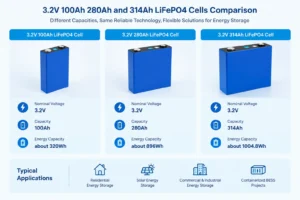
Different battery cell capacities provide different advantages depending on project requirements.
| Battery Cell Type | Capacity | Typical Applications | Main Advantages |
|---|---|---|---|
| 3.2V 100Ah LiFePO4 Cells | 100Ah | Residential and small energy storage systems | Flexible configuration and easy integration |
| 3.2V 280Ah LiFePO4 Cells | 280Ah | Commercial and industrial energy storage | Higher capacity and reduced system complexity |
| 3.2V 314Ah LiFePO4 Cells | 314Ah | Large-scale energy storage projects | Higher energy capacity and improved space utilization |
There is no single battery cell specification suitable for every application. The ideal choice depends on factors such as system size, installation environment, required energy capacity, and project design goals.
How Does Battery Cell Capacity Affect Energy Storage System Performance?
Battery cell capacity has a direct influence on the overall design and efficiency of an energy storage system.
System Design Efficiency
Higher-capacity cells can reduce the number of individual battery units required to achieve the same energy storage capacity. This can simplify battery pack assembly and improve production efficiency.
Space Utilization
For commercial and industrial projects, installation space is often limited. Larger-capacity cells allow more energy storage within a compact system footprint.
Maintenance and Management
A simpler battery structure can reduce the number of monitoring points and make battery management easier.
However, smaller capacity cells still provide advantages in applications that require flexible configurations and customized system designs.
What Should Energy Storage Companies Consider When Using LiFePO4 Battery Cells?
When developing an energy storage solution, companies should consider several important factors:
Project Energy Requirements
The required storage capacity determines the suitable battery cell specification. Large-scale projects usually benefit from higher-capacity cells, while smaller systems may require more flexible configurations.
Battery System Design
Cell capacity should match the inverter system, battery management system (BMS), and overall system architecture.
Operating Environment
Temperature, installation location, and charging conditions can affect battery performance. Proper system design helps maximize battery reliability and service life.
Choosing the right battery cell is not only about capacity but also about ensuring compatibility with the complete energy storage system.
How Are LiFePO4 Battery Cells Supporting Renewable Energy Development?
The growth of solar and renewable energy has increased the demand for reliable energy storage solutions. Battery cells provide the foundation for storing excess renewable energy and delivering stable power when needed.
From residential systems using flexible 100Ah cells to commercial and industrial projects using 280Ah and 314Ah large-format cells, LiFePO4 technology continues to support more efficient and reliable energy storage applications.
Understanding the differences between different LiFePO4 Battery Cells helps manufacturers, system integrators, and project developers create better solutions for various energy storage requirements.